 Flames of Oppression Chapter 3
For the first time in as long as he could remember, Hur did not wake to the sharp crack of a Nagaresh whip, the thud of an iron-toed boot against his ribs, or the distant roar of a Roc. There was no iron grate above his head, no smell of stale urine and damp straw.
Instead, he woke to the muffled rustle of people starting their day, the distant bleating of goats, and the sound of soft footsteps on dirt.
He blinked, his eyelids scraping like sand. The ceiling above him was a tight weave of palm fronds, yellowed by age and laced together with coarse hemp twine, supported by thick, gnarled tamarisk rafters. The roof smelled sharp and tarry from the layer of raw bitumen that sealed the thatch. Shadows danced across it, thrown by a small tallow lamp on a low stool nearby.
The air didn't bite at his throat. It was warm and soft, heavy with the earthen damp of the hot springs and the smell of baking flatbread and fresh mint.
Hur tried to bolt upright, every instinct screaming at him to find a weapon, to look for the scaled faces of his captors.
A hand, small but surprisingly firm, pressed against his shoulder.
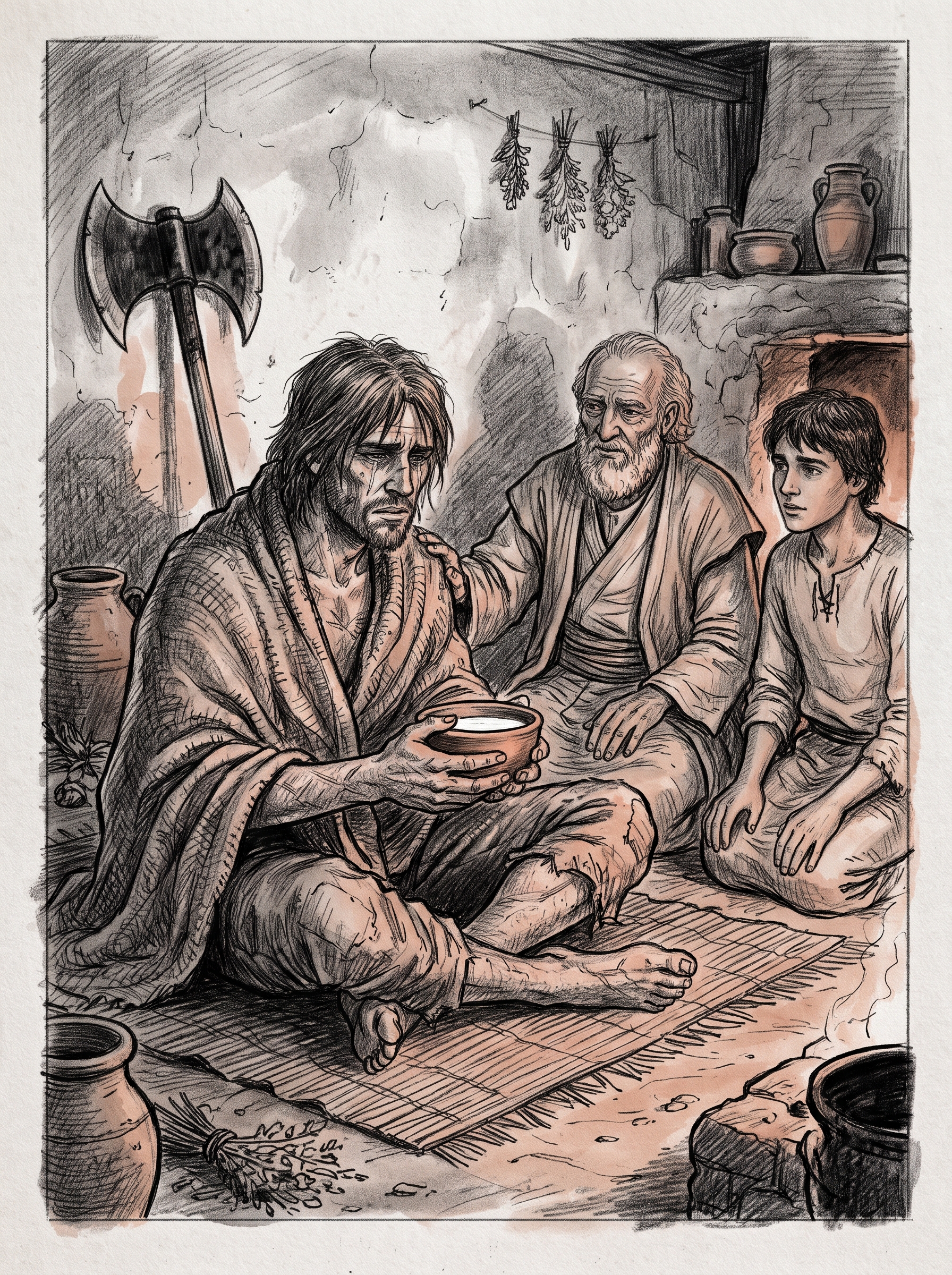
"Easy, traveler," a voice said. It belonged to an old man sitting on a woven mat beside the pallet. His face was a map of sun-carved wrinkles, his eyes clouded by cataracts, yet they held a calm Hur had never seen in another living soul. "Your flesh has mended, but your blood is still thin. Lie back."
Hur sank into the mattress. It was stuffed with dried spring reeds and soft goat hair. The luxury of it felt alien, almost repulsive, to a body used to the bare dirt of the camps.
The old man reached down and lifted a small earthenware bowl. Steam curled off the top, carrying the fatty scent of warm goat's milk thickened with a mash of starchy tuber roots. He didn't toss it at Hur's feet. He didn't make him beg or crawl for it while guards wagered on how fast he would lap it from the floor. He simply held it out, the wooden spoon resting against the lip of the bowl.
Hur's hands shook so badly he nearly spilled the milk when he took it. He didn't use the spoon. He brought the bowl to his cracked lips and drank.
The warmth hit his throat like life itself, washing away the lingering taste of ash and iron. It was rich, sweet, and heavy with starch. In the open-air prison camps of Balad, a meal like this was an impossibility. It was something men died for, something a brother stole for his dying sister, something hidden under rags and eaten in the pitch black while holding one's breath.
A hot, stinging moisture pricked the corners of Hur's eyes. He tried to swallow the lump in his throat, but a sob broke from his chest anyway. Tears cut through the dirt on his cheeks and dripped into the white milk. He drank faster, trying to hide the sound, burying his face in the bowl until his chest heaved. It was the first time he understood, with crushing clarity, that people could live without being treated like livestock. Peace wasn't only the absence of war. It was the quiet dignity of a warm bowl of milk offered by a stranger.
The old man didn't comment on the tears. He watched with patient respect, waiting until Hur set the empty bowl in his lap.
"I am Akhtar," the old man said softly, gesturing around the small, circular hut. "The folk here call me the hakeem."
Hur wiped his mouth with the back of his hand. His skin felt strange, tight and smooth across his chest where the Arkhaean's claws had torn him open. He pulled aside the coarse, clean linen tunic they had dressed him in. The deep gashes were gone. In their place were thick, pale scars that looked weeks old, though his memory said the blood had been fresh only days ago.
"How?" Hur's voice was a cracked rasp, his throat raw.
Akhtar leaned forward, his clouded eyes settling on Hur's chest, then shifting to the corner of the hut. There, leaning against the wall, was the soot-blackened Arkhaean axe. Its head was cold now, but the dark metal seemed to swallow the lamplight.
"That is what I hoped to ask you," Akhtar said. "Your clothes were scorched to ribbons. The skin beneath was seared shut, as if you had been dragged through a glassmaker's kiln, yet there was no infection. No rot. Just an empty belly and a body that had run itself into the earth. Where did you come from, boy?"
Hur looked away, toward the small, square window cut into the wall. "Ma'bar," he whispered. "In the heart of Balad." The name of his ruined home felt like a stone rolling off his tongue. "They... they let us loose in the dunes. For a wager. A hunt."
He didn't mention the fire that had poured from his eyes. He didn't mention the way the oasis pool had hissed, or the weight that had settled into his bones before he threw the axe. He didn't have the words for it anyway. He told the old man only of the running, the exhaustion, the hunters cornering him by the water, and the desperate, bloody scramble in the rocky ravine with the stalkers.
Akhtar listened without interrupting, his fingers slowly stroking his silver beard. When Hur finished, the old man stood, his joints popping in the quiet room.
"Come," the hakeem said. "There are those who need to see you are among the living."
Leaning on a walking stick Akhtar provided, Hur stepped out of the hut. The sight of the canyon floor stopped him in his tracks.
"Welcome to Milh," Akhtar said, gesturing to the village sprawling within the deep rift known as Wadi Al-Milh.
The architecture was unlike anything Hur had seen. The houses did not merely sit on the earth; they were built into it. The canyon walls were pockmarked with quarries where the villagers cut volcanic tuff, a soft, porous rock of consolidated ash. The houses were built of these pale blocks, bound with a cement of fine ash, lime, and brackish water. The inner walls of the nearest dwellings showed a hard, chalky gray-white finish, a sun-dried adobe mixed with desert scrub and salt crust skimmed from the thermal flats, which Hur would later learn kept out pests and held the warmth through the freezing canyon nights.
The village was small, perhaps fifty or sixty stone-and-mud homes clustered around steaming mineral pools. Because the sulfur-choked soil rejected grain and root, the villagers lived on what they could trade for. Flour, grain, and tubers came up from the lowlands in exchange for salt, sulfur, and bitumen, and the settlement ran on a harsher rhythm.
Looking up at the towering basalt cliffs, Hur saw mud-brick pigeon towers honeycombed into the rock face. Thousands of rock doves wheeled above them like smoke, flying out to forage across the plains and returning at dusk to give the village meat, eggs, and the guano that fertilized its tiny stone-walled terrace gardens. Down on the valley floor, older men and youths were returning from the thermal flats, carrying baskets of glistening yellow sulfur and blocks of white rock salt cut from the steam vents. Near the western fringe of the dwellings, a sharp, sweet, fermented odor drifted from a small building where the stunted, bitter fruit of the local date palms was being distilled into Wadi Fire, the high-proof spirit traded for coin.
A short distance away, a middle-aged man sat on a low bench of tuff in the shade of a tamarisk tree. A young boy, no older than seven, sat between his knees. The man's large, calloused hands guided the boy's smaller ones, showing him how to angle a small iron blade against a block of cedar. A shaving of wood curled away and fell into the white salt-dust, and the boy let out a bright, clear laugh that echoed off the canyon rims.
Hur watched them, his heart aching. He had forgotten that fathers could teach their sons anything other than how to hide under wagons or how to muffle their breathing when a Roc flew low.
A small group of villagers had gathered near the hot springs. Three older men, their tunics clean but simple, stepped forward. The elders of Milh.
"He says he is a child of Balad," Akhtar announced to the gathering, placing a hand on Hur's shoulder.
The tallest of the elders, a man named Elan, looked at Hur. There was no hostility in his gaze, only sorrow and a flicker of fear. His eyes went to the pale scars showing at Hur's collar, then up to the high canyon rim, toward the camps beyond. The two men behind him glanced at the same horizon and looked quickly away.
Hur had seen that look before, on people who had been spared once and knew it was only a matter of time. It was the look of men studying a mirror.
He would learn the rest over the following weeks. Here in Edom, the villagers were technically free, allowed to keep their elders and their customs, but their freedom lasted only as long as their quotas of salt, sulfur, and bitumen reached the Nagaresh Kingdom on time, an arrangement made by their own king. Whatever stood between Milh and the camps was a treaty, and a treaty was only as good as the parchment it was written on.
Elan stepped closer, placing a hand over his heart.
"You are a guest under our roof, son of Balad," Elan said firmly, his voice cutting through the hiss of the steam vents. "In Wadi Al-Milh, you are among friends. Wash the dust of the dunes from your throat, eat until your strength returns, and rest. You are safe here."
The villagers nodded, murmuring words of welcome. A woman stepped forward and pressed a fresh, warm round of flatbread into Hur's hand before retreating to her family.
Over the next two months, Hur learned the rules by which Milh bargained with heat and poison.
The village woke long before dawn, while the canyon floor was still freezing. Hur, determined to earn his keep rather than be a helpless mouth to feed, joined the men on the morning shift. With damp linen cloths wrapped around their faces to protect their lungs from the fumes, they descended into the blinding, sulfurous steam vents. Hur put his returning strength to work scraping raw bitumen from the oil seeps and hauling jagged blocks of rock salt.
By midday, when the sun beat straight down into the box canyon and turned the rift into an inferno, the village fell silent. Hur retreated with the others into the cellars of the tuff-stone homes to wait out the blistering hours, helping the women mend wooden tools and pit bitter dates for the distillery.
As the sun finally dipped behind the high western cliffs, the canyon came back to life. Tamarisk wood and bitumen blocks were lit in communal hearths, throwing long, orange shadows against the white-salted adobe walls. The day ended at the stone bathhouse, carved directly over a natural hot spring.
Plunging into the hot, mineral-heavy water alongside the men of the village, Hur felt the salt dust and sulfur grease melt from his skin. In the steam, something in him that had been clenched since the cistern began to ease. He listened to the younger men swap stories of the traders who came to buy Wadi Fire. Jamil, the weaver's son, would boast about racing camels across the rocky flats, his laughter bright and untroubled, and once tossed Hur a wooden ball to pass between the pools. Hur listened as the older men sang low, mournful songs of Edom's past, a time when it was ruled by its own free royals, not puppets set on the throne by Arkhaeans and Nagaresh. They asked him about his life before the camps, listening in respectful silence as he shared fragments of a home that had burned to ash.
They poured water over his scarred shoulders, patted his back, and shared their tobacco. They didn't ask about the blackened axe that stayed in Akhtar's hut, and they didn't treat him like a broken refugee. They accepted him into their rhythm, offering him the one thing the Nagaresh had tried to kill: his humanity.
While the villagers of Milh moved at the valley's gentle pace, Hur lived in a state of quiet, perpetual siege. The power he thought had abandoned him in the ravine had never gone dormant; the thing had merely burrowed into his marrow, pacing the cage of his ribs like a starved predator. He felt it with every waking breath. A dense knot of old heat that left his blood tasting like boiling copper.
It had no patience for the peace of the sunken valley. It despised the soft hum of mothers' lullabies, the scrape of the salt pans, and the easy laughter of children at dusk. It was a devouring wrath that answered only to violence, craving the thud of iron biting bone, the reek of scorched air, and the hot spray of blood. It hungered for war.
Every waking hour was an act of will for Hur. When he helped haul the salt blocks, his knuckles turned white, his muscles locking as the entity begged him to hurl the stones through the tuff walls just to watch them shatter. In the midday rest, he had to clench his jaw until his teeth almost cracked, fighting down the urge to scream in a voice that was no longer his own. He was terrified. If he lost his grip for even a second, the fire would erupt again, and this fragile haven of white-crusted mud and palm thatch would be reduced to a smoking crater.
The villagers noticed the strain. They saw the way Hur would freeze in the middle of a conversation, his eyes tracking something invisible, sweat beading on his pale face. They saw his hands tremble when he held a simple wooden bowl. But they didn't see the monster beneath the skin.
"The camps break a man's spirit," Hur once overheard Elan say to the other elders over the evening hearth. "He hears the shrieks of Rocs even in the quiet. Give him time."
They put his silence down to the ghosts of Ma'bar, the common madness of a man who had outlived his entire clan. Hur let them believe it. It was easier than telling them he was a walking tinderbox.
One night, the sulfur mist hung low, trapping the freezing air in a yellow blanket. Hur couldn't sleep. The entity thrashed against his mind, roaring for a battlefield, filling his head with visions of wars and bleeding empires.
Gasping for air, he slipped out of Akhtar's hut, leaning on the soot-blackened Arkhaean axe like a crutch to steady his shaking legs. He walked toward the dark perimeter of the village, near the narrow mouth of the canyon where black pits bubbled in the gloom.
Through the swirling mist, Hur saw a silhouette.
It was Jamil, the weaver's son, who had tossed him a wooden ball in the bathhouse. Jamil was walking in a glassy-eyed daze, arms slightly outstretched. A few paces ahead of him stood a woman.
She was beautiful, her skin glowing like polished ivory in the moonlight, her dark hair falling in silky waves over a shimmering white gown. She smiled, a soft, hypnotic expression, and held out a slender hand to Jamil, humming a melody that sounded like a lover's promise.
But the air around her didn't smell of mint or fresh bread. It smelled of rot. Of old graves and sun-dried carrion.
Inside Hur, the beast in his blood surged. The recognition came up through his marrow rather than his mind, a knowledge that was not his own. Ghoul. A desert horror, a shapeshifter that lured the unwary into the wastes to gorge on their flesh.
"Jamil, stop!" Hur yelled.
Jamil didn't hear him. He stepped past the final boundary stone of the valley, following the beautiful visage up the rocky embankment toward the open desert. The moment his foot cleared the ridge, the woman's face fractured. The ivory skin peeled back like rotting parchment, the silky hair dissolving into coarse, bristly needles. The jaw unhinged, stretching into a cavernous, tusk-lined maw dripping black saliva. The white gown became matted gray hide.
Jamil snapped out of his trance too late. He stumbled back, tripped over a rock, and screamed as the thing lunged, its long, jagged claws raised to open his throat.
Before the claws could fall, a wave of violence hit the ravine.
The fire broke through Hur's veins like a ruptured dam. It didn't need to be begged this time. It wanted a fight, and Hur, driven by the need to save the boy, leaned into the dark.
With a burst of speed that cracked the volcanic stone beneath his boots, he crossed the distance in a heartbeat. He didn't use the blade. He swung the axe like a club, the dark metal singing through the air, and the flat of the head struck the ghoul square in the ribs.
The thing shrieked, a high, metallic wail, as it was launched sideways into the canyon wall.
Hur dropped the axe. The fury inside him wanted closer contact, a deeper taste of the kill. His eyes flared into an unnatural, molten orange, the pale scars across his chest glowing through his tunic. Heat rippled off his skin, searing the damp sulfur mist into bursts of steam.
The ghoul scrambled to its feet, hissing, long arms slashing. It raked its claws across Hur's forearm, but the wounds didn't bleed; they seared shut, glowing from within. Hur felt no pain.
He lunged, hands moving with impossible force, and caught the ghoul by the throat and the upper jaw. Its muscles bunched, trying to overpower him, but against the force inside Hur it was like a child fighting a mountain. A feral growl ripped from his throat. With a wrench of his whole body, he twisted his arms in opposite directions.
The sound of fracturing bone and tearing hide echoed through the quiet ravine. Hur ripped the ghoul's jaw clean from its skull in a spray of black, corrosive blood that hissed and smoked on the stones. The body dropped into the dirt, twitched, and went still.
The fire in his eyes lingered a few seconds, the thing savoring the end of the hunt, before it receded reluctantly into his bones and left him panting, slick with the ghoul's black blood, trembling in the sudden emptiness.
Jamil was cowering against the rock, his eyes wide with a terror that was now split evenly between the dead monster and the man who had killed it.
Hur closed his eyes, forcing his breathing to slow, desperate to look human again. He held out a shaking, black-stained hand to Jamil. "It's over," he gasped, his voice raspy but entirely his own. "You're safe."
The scream and the sounds of the struggle had already roused the village. As Hur guided a dazed Jamil down the embankment, a dozen men, Elan and Jamil's frantic parents among them, came rushing through the mist with torches and iron picks.
When the weaver saw his son alive, he dropped his weapon and threw his arms around the boy. Jamil, shaking, pointed back up toward the ridge.
"A ghoul..." Jamil sobbed, his voice cracking. "It had me. It looked like a woman... it was going to eat me. Hur... Hur stopped it. He destroyed it with his bare hands."
Elan and two of the sturdier youths climbed the ridge, their torches throwing flickering light over the scene. When they saw the torn remains of the ghoul, a creature that usually took half a dozen armed men to drive off, a stunned silence fell over the canyon.
They looked down at Hur, who stood in the thinning mist leaning on the axe, pale and spent, fragile once more.
The weaver stood, stepping past the elders. He looked at Hur not with fear or suspicion at his strange strength, but with the raw gratitude of a father given back his son's life. He grasped Hur's shoulders, his eyes bright with tears.
"Thank you," the man said, his voice thick. "Thank you, son of Balad. You saved my boy."
Jamil's mother pressed her hands to Hur's face, weeping blessings Hur hadn't heard since his own mother was alive. The villagers joined in, their voices a warm, rising chorus of gratitude, clapping his back and hailing him as a protector of the valley.
Hur smiled faintly, nodding back to them, but as he looked into their thankful faces, a cold dread settled in his stomach. They were grateful now, celebrating a miracle. But Hur could feel the thing shifting beneath his ribs, pleased by the blood it had tasted, stretching its limbs, and waiting for the next excuse to burn everything to the ground.
Chapter discussion