 Flames of Oppression Chapter 2
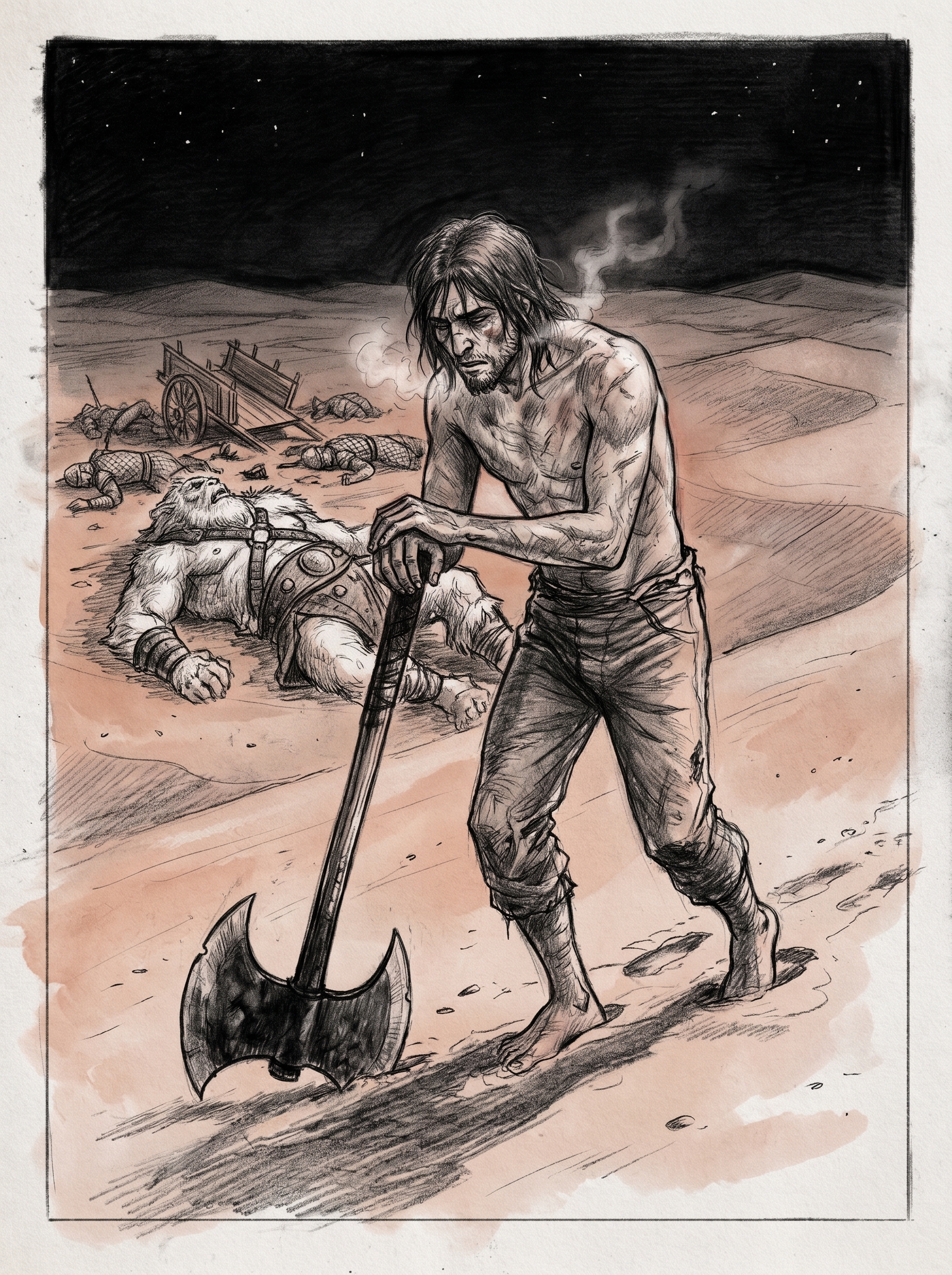
Hur stood in the center of the slaughter.
Around him lay the dead. The white-furred Arkhaean lay facedown in the silt, skull caved inward; the other two were strewn near the splintered debris of their two-horse carts, their limbs bent like felled timber. The Nagaresh were scattered across the sand, their dark scales crumpled where chests had been caved in or throats ripped bare. Near the southern edge of the dry bank, one of the carts rested on its side, axle snapped. Its draft horses were tangled in the leather traces. One lay stone-dead with its neck twisted; the other thrashed against the harness, forelegs broken and useless, kicking weakly at the dry silt.
The red-orange glare began to fade. The fire did not blow out in the evening wind; it receded, sinking into the meat of Hur's arms like molten glass forced through narrow bone.
Hur gasped, a choked, wet sound that rattled against his teeth. His skin cooled from incandescent to a raw, angry crimson. The pale steam curling off his forearms carried the stink of scorched air and charred meat, the scent of his own torn flesh searing shut under a foreign power his starved frame was never shaped to house.
The thing that had answered his hatred had stitched his mortal wounds, but the cost came at once: a hollow ache. The fire had burned through every reserve he possessed. His heart hammered, a tripping cadence trying to drive blood through vessels that felt lined with hot slag. His stomach clenched into a knot of nausea, screaming for salt, fat, anything to replace what the flames had consumed.
He looked down at the axe. The blaze was gone, but the dark metal stayed soot-blackened, radiating a dull, throbbing heat into the dusk. To a starved refugee, it felt heavy as an anvil. His forearms trembled, muscle fibers almost tearing under the weight of the head, but Hur refused to leave it behind. He wedged the haft into the damp earth and leaned on it like a crude staff to keep his knees from buckling.
He dragged himself toward the bodies.
His blistered fingers worked through the gore and scorched leather, rifling pouches and belts. From the Nagaresh he took a goatskin canteen, half-full of brackish water that smelled of sheep fat, and a linen pouch of silver dirhams stamped with the coiled serpent crest. From the seat of an overturned cart he tore open a traveler's sack: hard strips of dried, salted horsemeat wrapped in waxed cloth.
He didn't wait to chew properly. He tore into the jerky with his teeth, the salt burning his split gums, choking down the fibrous meat to stifle the gnawing in his gut.
He found a dead Nagaresh whose frame was closest to his own. Hur dragged the corpse over, peeled off the supple riding boots of dyed camel leather, and shoved his own swollen, raw feet into them. The leather was stiff, slick with another man's sweat, and a size too small, pinching his toes, but it shielded his cracked soles from the sand.
He turned his back on the pool.
He could not ride. The gelding had bolted into the wastes with the rest, and the only horse left in the oasis was dying in its traces. He could only walk. Hur struck out, away from Ma'bar and the trail the hunters had cut through the sand, desperate to shake any scout patrol that might follow.
He forced one foot in front of the other, the boots dragging deep ruts into the loose slopes of the dunes.
He hiked on as the night air turned freezing and his vision smeared into double images. Every joint in his spine begged him to drop into the lee of a ridge, let the sand drift over his shoulders, and sleep, but he pushed on without compass or road.
The desert began to warp around him.
The dead silence of the dunes cracked open, replaced by a roaring in his ears. It was a discordant clamor: the high, weeping shrieks of his mother and the cries of his sister being hauled away in the dark, layered beneath earth-shaking battle shouts in a tongue that tasted of sulfur and iron, a language entirely unknown to him. In the shimmering dark, he saw towering cities of black basalt crumbling into oceans of fire, their falling towers bleeding into the vision of his own clan's burning tents.
"Not now," he muttered to the shadows, his tongue thick and raspy as untanned hide. He leaned on the haft and shoved himself up the crest of another red dune. "I will join you. But not now."
By the time the moon reached its silver zenith, the dunes had given way to a maze of eroded limestone and jagged shale. Hur dragged himself into the mouth of a narrow, water-carved ravine, each breath rattling in his throat like dry peas in a gourd. The stolen boots were already caked in white dust and rubbing his blistered ankles raw, but he kept moving because stopping meant his legs would lock for good.
Then the hair on the back of his neck prickled.
He slowed, swaying, and leaned his chest over the haft of the axe.
Deep in the black of the rock clefts, two pairs of sulfur-yellow eyes caught the moonlight. The stalkers drifted onto the gravel floor with barely a sound. They were predators of the wastes, long and low-bellied, their backs armored in pebbled scutes that ticked faintly against the stones. Their thick shoulders tapered into wedge-shaped heads, and from their scaly muzzles jutted yellowed, upturned tusks flanking rows of bone-shearing teeth.
They tested the wind with flared nostrils and caught the scent of a dying man.
One darted forward, belly scraping the loose scree, claws clicking a rapid warning.
Hur reached inward. He clawed deep into his own marrow, begging for the inferno that had torn through the oasis, the fire that had snapped necks like kindling. But the thing that had answered him lay dormant, leaving behind nothing but an exhausted, starving Baladi whose hands shook so badly he could barely hold the haft.
The first stalker surged.
Its broad jaws snapped shut with a hollow clack, missing Hur's thigh by inches as he twisted sideways. Instinct seized his muscles before thought could, and he swung the axe in a desperate, sweeping arc. The momentum dragged him off balance. The blade bit the bed of the ravine and threw a shower of orange sparks across the stone with an ear-splitting crack.
The beast recoiled from the noise and flame, but the second scavenger had already timed its strike. It sprang, hind legs launching a hundred pounds of muscle and armored scale at Hur's throat.
Panic took Hur's heels. He tried to haul the weapon back, tripped on loose stones, and slammed his shoulder into the crumbling canyon wall. The tusks slashed past his collar, tearing his ragged tunic and missing his jugular by a fingernail's breadth.
The two predators split apart, armored hides rasping on the rocks, and began to circle. They kept low, tails lashing, waiting for the stumble that would end him.
The first stalker gathered its haunches and lunged again, going low for his knees.
Hur didn't swing wide this time. With the last reserve of fury in his back and shoulders, he brought the haft down in a vertical chop, falling with the weapon's weight.
Crack.
The blade caught the stalker square between its yellow eyes, cleaving through the armored snout and shattering the skull into the gravel. The creature convulsed once, claws scratching futile trenches in the stone, and went limp.
The second stalker froze mid-stride. It lowered its flat snout, looking from its twitching mate to the wild-eyed man swaying above it, chest heaving, massive axe dripping dark gore onto the shale.
A sharp, throaty hiss tore from its jaws. Realizing the prey had teeth deadlier than the man's broken frame suggested, it backed away step by step, pressed flat against the rock, and melted into the shadows of the ravine.
But the victory cost Hur the last thread holding him together.
The adrenaline drained away, leaving a void. Black spots swarmed across his eyes. His knees buckled, his fingers opened, and he pitched forward down the rocky slope, his body rolling limply over shale and scrub before the dark rushed up to swallow him.
When Hur's eyes dragged open, a full day had slipped past him and a second dawn was bleeding gray along the rim, but the heat of the sun had not found him.
Instead, a thick, acrid reek of sulfur burned his nostrils, mingled with the cool, damp breath of deep shadow. His legs were numb, cold stones dragging behind him, but he dug his raw elbows into the grit and hauled his torso forward an inch at a time across the sharp black basalt. He pulled his chin over a jagged lip of volcanic stone and looked down.
He had tumbled upon a ghost in the waste.
Far below lay a sunken world, carved into a colossal, ragged tear in the earth beneath the flat desert plain. From above, the rim would have looked like nothing more than an impassable sprawl of dead slag and shimmering mirages. But down in the cool, blue-shadowed gut of the chasm, life clung to the rock.
Flat-roofed dwellings of dried mud and rough-cut basalt were stacked in tiers against the cliff walls. Narrow irrigation channels trickled with clear water fed by subterranean fissures, bordered by green patches of wild herbs and hardy scrub. Thin plumes of sweet tamarisk smoke rose into the sulfur mist, hanging still in the windless canyon.
A hidden settlement.
Hur's trembling fingers lost their grip on the basalt ridge. The scree gave way beneath his chest, and he slid down the final embankment and tumbled into the soft dust of the valley floor.
His chin struck the dry clay. The axe slipped from his numbed palm, its iron head ringing dull against the stones.
Through the haze of his failing sight, figures broke through the morning mist, men in coarse-spun robes, their bronzed faces frozen in horror as they stared at his scorched, blood-caked skin and the axe lying beside him.
As the black tide pulled him under once more, a terrified shout bounced against the canyon walls:
"He's alive. Let's take him to the hakeem."
Chapter discussion